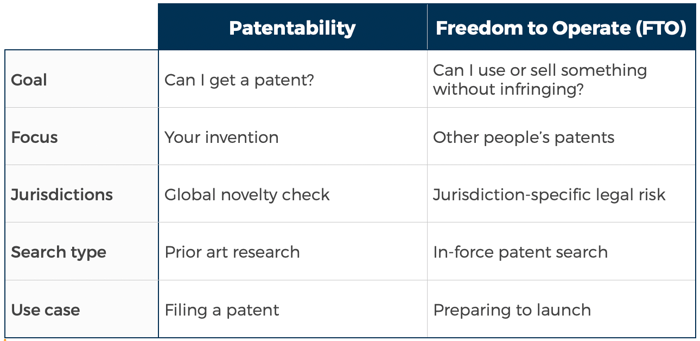
Patentability asks whether your invention is new enough to be granted a patent. Freedom to operate (FTO) asks whether you can make, sell, or use your product without infringing someone else's patent. An invention can be patentable but not free to operate — and vice versa. Understanding this distinction is crucial whether you're commercialising a technology or evaluating an investment.
1. Patentability: can you get a patent?
Patentability means your invention meets the criteria required to obtain a patent. It answers the question: can this idea be protected?
To be patentable, an invention must be:
- Novel — not already disclosed anywhere (including patents, articles, websites, or even your own slides).
- Inventive — not obvious to a professional in the field.
- Industrially applicable — it can be made or used in a concrete way.
→ In short, patentability is about what you can protect.
Example:
You invent a new coil design for wireless EV charging. If no one has published or patented this exact configuration, it might be patentable.
But even if your invention is patentable, you're not necessarily free to use it — that's where freedom to operate comes in.
2. Freedom to Operate (FTO): are you allowed to use it?
Freedom to Operate (FTO) means you're not infringing on someone else's patent in the jurisdiction where you want to make, use, or sell your product.
It doesn't matter if your invention is new or even patented: if someone holds a valid patent covering part of your solution, you may need a licence, or you risk infringement.
FTO is about understanding the legal space around your invention — not its originality.
→ In short: FTO is about what you're free to do — not what you own.
Example:
Your coil design may be new and patentable — but if an older patent claims "any wireless charging device with double-D coils," you might need a licence to sell it.

3. In a nutshell
4. Why this matters beyond the patent question
Patentability and FTO are essential — but they only tell part of the story.
A technology can be patentable, free to operate, and still face a crowded market with well-funded incumbents. Conversely, a space with dense patent activity can signal strong commercial opportunity — if you know where the gaps are.
This is why patent data alone is not enough. To make sound decisions — whether you're filing, building, investing, or licensing — you also need to understand the broader landscape:
- Who are the key players — and are they startups, corporates, or research institutions?
- Where is funding going — and does the investment activity confirm the commercial potential?
- What does the competitive positioning look like — and where are the white spaces?
- What are the scientific trends — and is the technology maturing or still emerging?
This is exactly what FTO Checker is built for. Our reports combine patent landscape analysis with market intelligence, competitive positioning, funding data, and scientific publications — giving you a complete picture in under 90 seconds.
Whether you're an inventor assessing freedom to operate, a founder preparing to raise, or an investor evaluating a deal — the question is never just "is this patentable?" It's "is this worth pursuing?"